
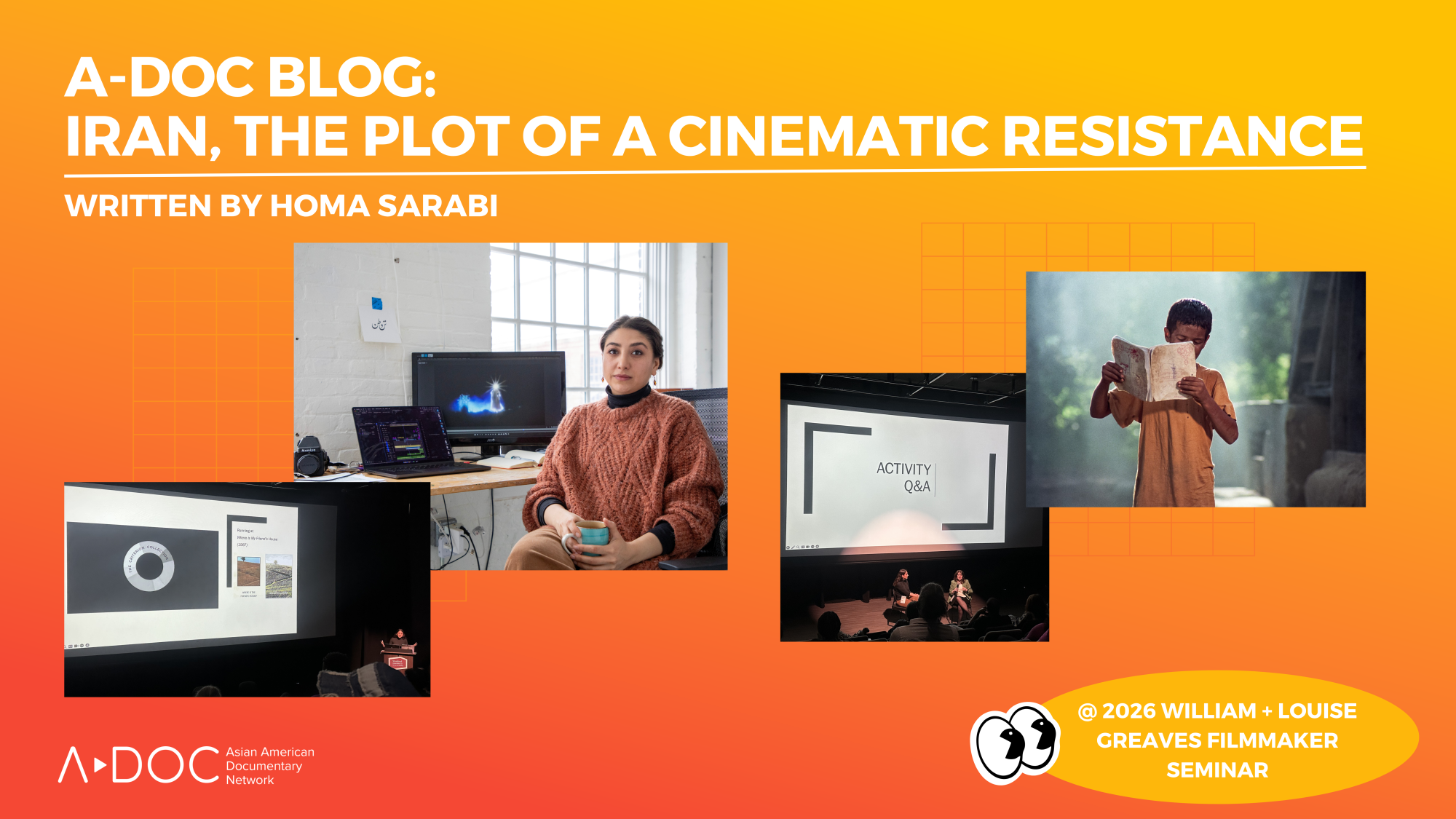
A-Doc member Homa Sarabi co-hosted a workshop about Iranian film at the 2026 William and Louise Greaves Filmmaker Seminar, a gathering for Black, Brown, and Indigenous artists working in cinematic realms. Homa is an Iranian-born artist, educator, and curator, living in the U.S. Working across film, installation, and socially engaged practices, her work explores the intersection of personal and political, investigates collective memories, and researches contemporary histories.
Read her editorial below:
Escaping the historical, record-breaking cold and brutal winter of the East Coast and taking refuge in the calm early March blooms, the fragrant bliss of the empty campus of Stanford during spring break, I was thankful to at least be at the right place at the most wrong time of the last couple of decades. Being at the William and Louise Greaves Seminar during the first week of America and Israel’s attack on Iran felt additionally meaningful. Being present alongside many others who understand the fight, have lived through the brutal consequences of militarized capitalist imperialism, and have fought and resisted through the uniquely powerful medium of cinema was empowering and reassuring. There are ways to resist; we have resisted, and we will continue to do so. Pursuing victory is not what the movement against authoritarianism is about, that it would be paradoxical to ever be victorious in this paradigm and pursuit.
The outline of the seminar, following William Greaves’s footsteps, was inspiring in reminding me of a beaten path before and a long way ahead. Arriving at Michèle Stephenson’s keynote, sleepy after a coast-to-coast flight, I was both awakened and soothed in the calm of the dark theater, the cocoon of the collective mind, as her speech unfolded the importance of activating archives and revisiting them often through the creative process.
Along with my co-presenter and fellow A-Doc member Yasaman Baghban, we spent much of our time focusing on adapting our presentation with the sudden shift of our reality after the January massacre in Iran and the war imposed by the U.S. and Israel.
Our panel was titled Iran, The Plot of a Cinematic Resistance and investigated the strategies employed in post-revolutionary Iranian cinema in order to resist the rigorous and unforgiving censorship apparatus imposed after the regime change in Iran. Recurring themes and protagonists, such as children, villagers, nomads, and lower-class urban citizens, were not merely evasions of censorship but a deliberately poetic and allegorical visual language with deep cultural roots. Focalizing through children and locating action in rural spaces, filmmakers such as Abbas Kiarostami, Bahram Beyzai, Jafar Panahi, Amir Naderi, and Majid Majidi developed forms that satisfied the new moral-aesthetic of the Islamic regime while retaining space for layered critique. Drawing on theories of allegory and close readings of WHERE IS THE FRIEND’S HOUSE?, BASHU, THE LITTLE STRANGER, THE MIRROR, THE RUNNER, and CHILDREN OF HEAVEN we show how these films translate restrictions on gendered representation—especially urban modern womanhood—into ethics of looking, parable structures, and self-reflexive folds where cinema is not only the tool but also the subject of critique of power, in examples such as THE MIRROR by Jafar Panahi.
This panel was shaped through months of organic conversations around Iranian cinema and the ways it has shaped our imagination and understanding of ourselves, individually and collectively. While many conceptualize national cinema through production, representation, and reception within the framework of the nation-state, Hamid Dabashi challenges the stability of this category altogether. In Close Up: Iranian Cinema, Past, Present and Future Dabashi* argues that Iranian cinema operates as a transnational and post-national formation, shaped by historical rupture, global circulation, and political constraint, thereby exceeding the boundaries of the nation as an analytical category. Following his argument in our panel, we talked about the ways Iranian society found its cultural balance through cinema after a decade of turmoil as a result of a revolution and a long war.
The spine of our studies was five films that had children as their main protagonists, a choice that was not only practical and clever in bypassing the strict mechanisms of censorship imposed by the Islamic Republic but also a reflexive gesture toward the reality of a new nation in the making, out of an ancient culture.
The children of Iranian cinema are not only innocent characters within the societal dilemmas and ethical narratives of these films but are also a self-portrait of a people in relentless pursuit of freedom and dignity, who often find themselves as helpless and lonely as the characters of these films do.
Right before our panel, we gathered along with other A-Doc seminar participants while sharing a meal; feeling at home can take many shapes, and A-Doc has been a community that has most warmly welcomed me and my work in this past year. Reflecting back on the experience of the seminar and arriving home while the stubborn snow is softened under the sun, I am thankful for the community BlackStar and A-Doc provided me with, especially amidst the horrors of this unraveling world.
*Hamid Dabashi, Close Up: Iranian Cinema, Past, Present and Future (London: Verso, 2001).Film list:
Where Is the Friend’ s House?, directed by Abbas Kiarostami (Iran: Kanoon, 1987).
Bashu, the Little Stranger, directed by Bahram Beyzai (Iran, 1989).
The Mirror, directed by Jafar Panahi (Iran, 1997).
The Runner, directed by Amir Naderi (Iran, 1984).
Children of Heaven, directed by Majid Majidi (Iran, 1997).